
- Home
- Products
- OEM Service
- Industry Solutions
- Case Studies
- About Us
- Resources
- Contact
inquiry now
Leave Your Message
Engineered for zero-tolerance zones in food processing and pharmaceutical manufacturing plants.

Maximum particle containment with integrated hood and boots, ideal for high-risk food processing and pharmaceutical formulation areas.

Lint-free, static-dissipative fabric prevents dust attraction and maintains pristine hygiene in dry food processing and dairy plants.

Classic cleanroom protective coat with secure stud closures and elasticated cuffs to prevent biological contamination shedding.
Premium medical scrub set adapted for food processing personnel working in cleanroom packaging and testing environments.
Why modern food safety mandates the adoption of pharmaceutical-grade cleanroom garments.
The global food manufacturing landscape is undergoing a massive paradigm shift. As consumer demand for preservative-free, ready-to-eat (RTE) foods, organic products, and advanced nutraceuticals skyrockets, food processing plants are forced to implement stricter environmental control protocols. Historically, the level of cleanliness required in food processing was limited to basic sanitation—hairnets, aprons, and gloves. Today, however, high-risk food manufacturing environments are adopting pharmaceutical cleanroom garments to meet stringent regulatory standards and extend product shelf life without chemical preservatives.
The primary source of contamination in any controlled environment is the human operator. Humans shed thousands of skin cells, micro-organisms, and hair particles every minute. In a standard food processing line, these biological particles can settle on food surfaces, introducing pathogens like Listeria monocytogenes, Salmonella, and E. coli. By integrating pharmaceutical-grade cleanroom garments—which are specifically engineered to filter and contain microscopic particles—food processing plants can achieve a level of hygiene comparable to sterile drug manufacturing facilities. This crossover between pharmaceutical technology and food safety is not just a trend; it is becoming the benchmark for industry leaders worldwide.
High-density woven polyester fabrics prevent human skin flakes and microbes from escaping into the production zone.
Integrated carbon grid threads prevent static build-up, reducing dust attraction in powdered food processing.
Designed to withstand rigorous autoclave sterilization cycles and high-temperature industrial laundering.
Not all food processing zones require the same level of protection. The utilization of pharmaceutical cleanroom garments is highly targeted toward specific high-risk operations where contamination would result in immediate product spoilage, costly recalls, or public health crises.
1. Aseptic Liquid Packaging and Dairy Processing: In the production of ultra-heat-treated (UHT) milk, baby formula, and liquid nutrition products, the filling zone must remain completely sterile. Any airborne contaminant can ruin entire batches. Operators in these areas wear full-body pharmaceutical coveralls with integrated hoods, face masks, and cleanroom boots to maintain an ISO Class 5 or Class 6 environment.
2. Ready-to-Eat (RTE) Food Formulation: RTE products do not undergo further cooking or heating by the consumer before consumption. This means the packaging phase is the final defense line. Utilizing lint-free cleanroom scrubs and smocks ensures that no physical or biological contaminants are introduced during the final packaging steps.
3. Alternative Proteins and Cultured Meat Labs: The rise of cellular agriculture and lab-grown meat has brought pharmaceutical-grade bioreactors directly into the food sector. Culturing meat cells requires sterile lab environments identical to biopharmaceutical cleanrooms. The garments worn by cell-culture technicians must prevent any cross-contamination that could ruin the delicate cellular growth media.
The market for cleanroom apparel in the food sector is experiencing rapid technological evolution. One major trend is the adoption of Smart Garments. Manufacturers are embedding RFID tags into cleanroom garments to track their laundry cycles, sterilization history, and overall lifespan. This ensures that every garment worn on the factory floor meets the exact filtration efficiency standards required by regulatory bodies.
Another crucial commercial trend is Sustainability. Historically, many high-risk zones relied on single-use disposable garments. However, environmental regulations and corporate sustainability goals are driving a transition toward reusable, high-durability pharmaceutical garments. These garments are constructed from advanced synthetic fibers that can be washed and sterilized hundreds of times without losing their particulate barrier performance, significantly reducing the carbon footprint of food manufacturing facilities.
Our OEM product range includes medical scrub, medical clothes, medical scrubs, medical uniform, medical uniforms, scrub set, scrub sets, scrubs set, nursing scrubs, nursing uniform, nursing uniforms, scrubs, doctor uniform, and other professional healthcare uniforms. We also provide customized workwear solutions for food processing, pharmaceutical production, cleanroom, and other professional industries.
How we tailor our pharmaceutical cleanroom garments to meet the precise requirements of food processing plants.
Our sales representatives first communicate with customers in detail to understand their product positioning, application scenarios, style requirements, fabric needs, color matching, logo process, packaging method, and order quantity.
After confirming the requirements, our professional clothing designers can provide garment design drawings to help customers clearly review and confirm the style.
After the customer confirms the design drawing and style solution, we can recommend suitable fabrics according to the product application, or match fabrics based on the customer’s preferred or specified materials.
Then we proceed with pattern making, sample development, sample confirmation, and bulk production to ensure that each product meets the customer’s brand positioning and market requirements.
Ensuring strict adherence to pharmaceutical and food safety standards through precision manufacturing.
Customer logos can be applied through multiple techniques, including embroidery logo, screen printing logo, heat transfer logo, heat press logo, 3D logo, care label logo, woven label logo, and other branding methods. According to different fabrics, garment styles, and brand requirements, we can recommend the most suitable logo solution for each project.
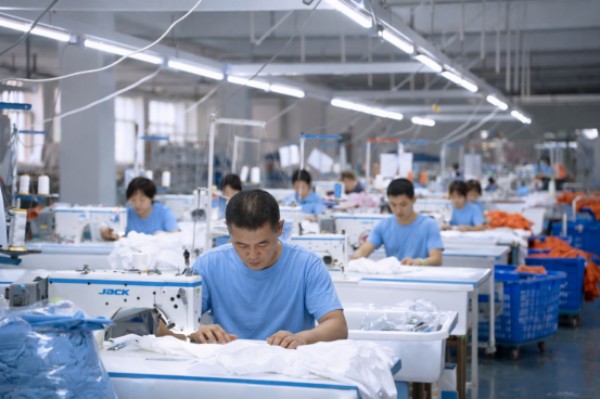
Sanxia Technology focuses on high-quality sewing workmanship and stable production quality. We strictly control details such as garment pattern, stitching, binding, overlock seams, buttons, zippers, pockets, cuffs, waistbands, and other production details. Our goal is to provide customers with professional workwear products that are neat in appearance, comfortable to wear, and durable for daily use.
Our products are mainly exported to Japan, South Korea, Europe, America, the Middle East, Southeast Asia, and other countries and regions. We specialize in OEM private label manufacturing for various brand customers. We support a minimum order quantity of 100 sets, fast delivery, and responsive service. With rich production experience and professional service capability, Sanxia Technology has served more than 10,000 customers and has become a trusted OEM workwear manufacturing partner.
Understand client brand positioning, industry standards, usage environment, functional needs, style, color, logo, packaging, delivery schedule, and quality acceptance requirements.

Create original designs in compliance with industry regulations. Develop patterns, optimize ergonomic fit, confirm color matching, logo position, craft details, and finalize design documents after client approval.
Select suitable fabrics based on functionality, durability, safety standards, and client preferences. Provide fabric swatches and confirm composition, weight, color fastness, and performance.
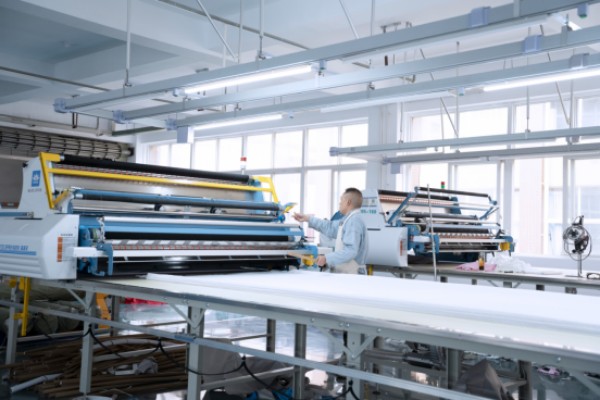
Conduct fabric inspection and dust removal. Arrange efficient nesting and spreading. Perform precision cutting, label parts by size and batch, trim edges, and inspect dimensions.
Implement standardized sewing processes. Use safe and compliant accessories. Reinforce high-stress areas, control thread trimming, and conduct semi-finished product inspections.
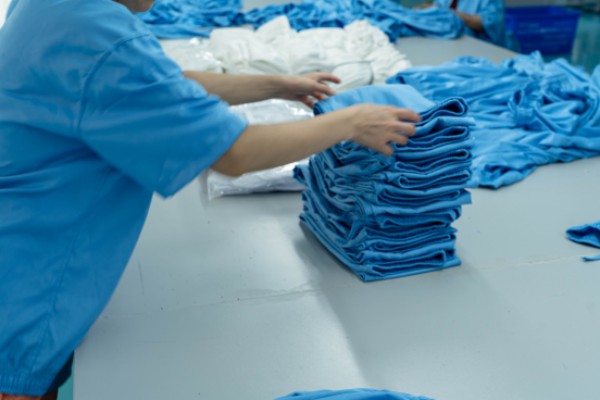
Check overall workmanship, sizing, printing, embroidery, accessories, hygiene, and safety. Filter out non-conforming products and keep complete inspection records.

Pack according to order requirements, apply labels, arrange shipment, and provide real-time tracking information.
Understanding the material science and design parameters of high-specification contamination control workwear.
When selecting pharmaceutical cleanroom garments for food processing plants, the choice of fabric is the most critical decision. Standard poly-cotton blends common in low-risk food production are completely unsuitable for aseptic or high-hygiene zones. These materials shed a significant volume of natural lint fibers, which can easily find their way into food products, causing contamination and potential batch rejections. Instead, cleanroom apparel must be manufactured from continuous filament synthetic fibers, primarily polyester. These fibers are tightly woven to create a barrier that prevents human particles from passing through, while remaining highly breathable for operator comfort during long shifts.
Furthermore, static electricity poses a significant hazard in dry food processing facilities, such as those handling powdered milk, flour, starch, or spices. Airborne dust particles can become electrostatically charged, leading to dust accumulation on operators' clothes, or in worst-case scenarios, triggering dust explosions. To mitigate this risk, high-quality cleanroom garments incorporate a grid of conductive carbon threads spaced at regular intervals (typically 5mm or 2.5mm). This grid dissipates static charges safely, ensuring that dust does not adhere to the fabric and reducing the risk of electrostatic discharge (ESD) in sensitive zones.
The design of the garment is just as important as the fabric itself. Cleanroom garments intended for food plants must feature a streamlined design that eliminates any potential dirt traps. This includes:
By adhering to these strict design principles, food processing facilities can achieve compliance with international standards such as ISO 14644 (Cleanrooms and associated controlled environments) and HACCP (Hazard Analysis Critical Control Point) systems, protecting both their brand reputation and the consumers they serve.
Explore our full range of professional cleanroom and food-safety garments customized for your processing facility.
Designed for ISO Class 5 cleanrooms with integrated hood and elastic seals.
Static-dissipative smock for dry food processing and packaging lines.
Durable polyester work coat featuring covered snap buttons and knit cuffs.
Comfortable, breathable scrub sets designed for daily food lab wear.
Autoclavable full-body protection with superior filtration efficiency.
Designed specifically for ready-to-eat (RTE) packaging areas.
Includes anti-static boot covers, hoods, and sleeve protectors.
Waterproof and chemical-resistant cleanroom garments for washdown zones.
© Sanxia Technology. All Rights Reserved. Specializing in high-quality OEM/ODM workwear and cleanroom solutions.