When global buyers are on the hunt for nursing scrubs, they’re not just after flashy colors or the cheapest quote—it’s way more than that. These garments have to survive marathon shifts, get washed again and again, and keep up with all that constant back-and-forth movement. Honestly, that’s where the real value lies. Florence Nightingale—you know, the founder of modern nursing—once wrote that the absolute first requirement for a hospital is that it doesn't harm the sick. She definitely wasn't thinking about scrubs or anything like that, but her idea actually applies pretty well to medical workwear. I mean, the whole point is that your gear should help you give safe, practical care, not get in the way or cause issues.
Okay, so here's the deal – we've checked out all the top scrub suppliers for 2026, and I mean really dug into their fabrics, seams, sizing consistency, customization options, production capacity, and whether they actually have documented quality control processes. And honestly, the little things matter way more than you'd think. Like, a pocket that can barely hold a pen without sagging, or a waistband that decides to twist around your hips halfway through your shift, or colors that fade after a handful of washes – those things can ruin your whole day and make you think twice about reordering. So before you jump in with any supplier, make sure you ask for fabric specs, size charts, some sample garments to feel in your hands, and get a clear estimate of lead times. Don't skip those steps, trust me. And hey, don't forget to ask suppliers how they deal with defects, either.
Honestly, no single ranking is going to work for everyone. Like, a small regional clinic ordering a few hundred sets—they might care a lot about flexible minimums, you know? While a big distributor is probably more focused on stable capacity and predictable restocking. Sure, price still matters, no doubt. But here's the thing: the cheapest sample isn't always the best deal in the long run. And you can't just take supplier claims at face value—you've gotta compare them against actual samples and written specs. That takes time, and honestly, it's easy to skip. I mean, who has the hours? But it's crucial. Alright, so the comparisons we're about to show you? They're more of a starting point than anything else. Don't get me wrong, they're not a replacement for doing your own due diligence as a buyer. And, well, some supplier details might change in 2026, so keep that in mind.

Nursing scrubs suppliers do more than manufacture shirts and trousers. They help global buyers select fabrics, size ranges, colors, and construction details for different care settings. Common options include breathable cotton blends, flexible waistbands, reinforced seams, and pockets sized for practical use.
Fabric weight matters, too. Heavy cloth may feel durable but become uncomfortable during long shifts.
A capable supplier can provide pre-production samples, size charts, color references, and inspection records. These let buyers check fit, stitching, and color consistency before placing larger orders. Small details count. Suppliers may also support private labeling, folded packing, carton marking, and shipment planning.
Buyers should confirm lead times, minimum quantities, and how defects are handled in writing. A low unit price can still mean higher costs if sizing varies between batches.
Even a clear specification may miss how a garment feels after repeated washing, so wear testing is worth considering. Supply chains are not always predictable; honest updates about delays are more useful than confident promises.
Scrubs supply is organized as a chain, not a single wholesale market. Fiber and fabric mills provide materials, including polyester-cotton blends and stretch knits. Cut-and-sew manufacturers turn those fabrics into tops, trousers, and warm-up jackets. Importers and uniform distributors then manage stock, sizing, and delivery. Large healthcare systems may purchase through centralized contracts, while smaller clinics often rely on local distributors or online wholesalers. The chain is layered.
Demand indicators help explain why suppliers serve different buyer groups. The U.S. Bureau of Labor Statistics’ Occupational Outlook Handbook projects 6% growth in registered nurse employment from 2023 to 2033, with about 197,200 annual openings. The World Health Organization’s 2020 workforce update projected a global shortfall of 10 million health workers by 2030. These figures describe workforce needs, not scrub sales. That distinction matters.
For buyers, supplier evaluation should follow the product through each stage. Ask who controls fabric specifications, where garments are cut and sewn, and how repeat orders are checked. Request size measurements, fabric composition, colorfastness results, and a sample that has been washed. A distributor may offer faster replenishment; a factory-direct supplier may offer more customization but require larger orders. Lead times can shift with fabric availability, and published capacity may not reflect peak-season output. The data is useful, but incomplete.
For global buyers in 2026, a leading scrubs supplier offers more than a low unit price. Look for clear fabric specifications, including fiber content, weight, stretch, and wash-care instructions. A useful supplier can explain how a fabric performs after repeated laundering, not just how it feels on a new sample. Details matter.
Sizing consistency is equally important. Request a size set and compare garment measurements across colors and production batches. Ask how the supplier checks seam strength, pocket placement, and color variation. These small checks can prevent larger problems when orders reach clinics in different regions. Sample review takes time.
Reliable communication also distinguishes stronger suppliers. Buyers should receive realistic production timelines, clear order minimums, and timely updates when materials or shipping plans change. Ask for quality-control records and a written process for handling defects. Claims are easy; specific records are more useful.
A low quote can still be attractive, but compare it with fabric life, reordering consistency, and delivery reliability. No supplier is perfect. Even a careful review may miss an issue that appears only after months of wear. That is worth acknowledging. Choose a partner willing to discuss limitations, share evidence, and improve when feedback reveals a gap.
These ISO test methods use a 1-to-5 grading scale, with 5 representing the best result. Ask suppliers for test reports for the specific fabric and color offered; this chart shows the standardized rating range, not supplier test results or rankings.
References: ISO 105-C06 (colour fastness to washing); ISO 105-X12 (colour fastness to rubbing); ISO 12945-2 (fabric pilling).
A supplier comparison should begin with the people who will wear the garments. The U.S. Bureau of Labor Statistics projects 6% growth in registered nurse employment from 2023 to 2033, a reminder that buyers may need to serve varied roles and body types. Check whether each range includes petite, tall, plus-size, and maternity options, not just a broad size label. Nursing Scrubs Women should be assessed for fit across real movements: reaching, bending, and carrying tools. Fit matters. A size chart cannot show whether a pocket pulls open when a wearer sits.
Quality needs evidence beyond a polished sample. Ask for fabric composition, weight, seam specifications, and test results for colorfastness and strength after repeated washing. AATCC TM61 evaluates colorfastness to laundering; compare results under the same test conditions. Do not assume heavier fabric is automatically better. It may feel durable but restrict movement or retain heat. The WHO’s 2022 global report estimates that 7% of patients in high-income countries and 15% in low- and middle-income countries acquire at least one healthcare-associated infection during care. Scrubs alone cannot prevent infection, but suppliers should provide clear care instructions and consistent quality controls. Test the seams. Request production samples from more than one batch, since one excellent sample may not represent regular deliveries.
| Comparison Dimension | What to Compare | Quality Evidence to Request | Buyer Evaluation Tip |
|---|---|---|---|
| Core scrub range | Check availability of scrub tops and trousers in multiple fits, sleeve lengths, colors, and size options. Confirm whether matching sets are offered. | Current product specifications, size charts, fabric composition, and pre-production samples. | Compare the actual styles and sizes available for repeat orders, not only the items shown in a catalog. |
| Supporting apparel | Look for relevant additions such as warm-up jackets, underscrubs, maternity styles, lab coats, and petite or tall options. | Separate specifications and samples for each garment type; confirm fabric and construction details by style. | Check whether the range supports a consistent uniform program without assuming every supplier carries every category. |
| Fabric options | Compare fiber content, fabric weight, stretch, hand feel, and care instructions. Common scrub fabrics include polyester-cotton blends and polyester blends with elastane. | Fabric test reports or mill documentation, composition labels, and wash-tested samples. | Assess comfort and performance on the intended wearer and use case; fiber content alone does not establish garment quality. |
| Color and finish consistency | Review shade availability, color matching across garment pieces, and consistency between production lots. | Approved color standard, production sample, and applicable colorfastness test results, such as testing to ISO 105-C06. | Agree on acceptable shade variation and approval procedures before bulk production. |
| Fit and sizing | Compare measurement charts, grading across sizes, fit options, and tolerance limits for key garment measurements. | Measurement spec sheet, graded size set, and sample review records. | Test samples across representative sizes; do not rely on a single sample size to judge the full size range. |
| Construction and durability | Inspect seam quality, reinforcement at stress points, pocket construction, closures, and finishing. | Pre-shipment inspection criteria, construction specifications, and sample garments after laundering. | Use a written checklist to compare samples consistently, including pocket placement and seam appearance. |
| Care performance | Review stated washing and drying instructions, dimensional stability, and appearance after repeated care cycles. | Test results for dimensional change, where relevant to the buyer's requirements, using a stated method such as ISO 6330. | Confirm test conditions and acceptance limits; results depend on the fabric, garment, and laundering conditions tested. |
| Pilling and surface appearance | Compare fabric appearance after abrasion and laundering, especially for garments intended for frequent wear. | Applicable pilling test results, such as ISO 12945-2, with the test method and rating scale identified. | Compare like-for-like test reports; a result is meaningful only when method and conditions are stated. |
| Restricted-substance documentation | Ask what chemical-compliance documentation is available for the fabric and finished garment. | Current, scope-matched test reports or certification documents. OEKO-TEX STANDARD 100, where applicable, tests textile articles for harmful substances. | Verify the certificate number, validity, and covered product or material. Do not treat a certificate as proof of every performance claim. |
| Quality management | Review how the supplier controls incoming materials, production checks, nonconforming goods, and corrective actions. | Documented inspection process and, if claimed, a current ISO 9001 certificate verified with its issuer and stated scope. | ISO 9001 concerns a quality management system; it is not a product-quality certification for scrub garments. |
| Customization and repeatability | Compare options for embroidery, private labels, color programs, and repeat orders against approved specifications. | Customization sample, approved artwork or color record, and documented change-control process. | Ask how the supplier preserves approved specifications when materials, trims, or production sites change. |
| Order and delivery readiness | Confirm quoted minimum order quantities, sample availability, production schedule, and shipping terms for the specific order. | Written quotation, order confirmation, production schedule, and pre-shipment inspection plan. | Compare like-for-like quantities, specifications, and delivery terms; lead times and minimums vary by supplier and order. |
Note: This is a supplier-comparison framework, not a verified ranking of individual companies. Confirm product claims, test reports, certificates, pricing, and delivery terms directly with each supplier before ordering.
Global buyers comparing nursing scrub suppliers should examine the full landed cost, not just the unit price. Request quotes at several order volumes, with fabric weight, size range, embroidery, packaging, and freight listed separately. Small charges add up. Confirm whether samples, color matching, and replacement pieces are included. A very low quote may rely on thinner fabric or limited size availability. Product photos rarely reveal that. For Nursing Scrubs Men, check chest, rise, inseam, and pocket placement across the size range; fit details can affect returns and repeat orders.
Capacity needs evidence. Ask for current monthly output, available production windows, and a realistic plan for repeat orders. Find out how the supplier handles fabric shortages, inspection failures, and peak-season demand. A spreadsheet helps, but cannot prove capacity by itself. Review recent production records or arrange a pre-shipment inspection when the order value warrants it. Delivery estimates should separate production time from transit and customs processing. Allow extra time for port congestion and local holidays. Agree on milestones for sample approval, cutting, packing, and dispatch. Buyers sometimes set deadlines too tightly. That can be a sourcing mistake, not a negotiation win. Keep specifications and change approvals in writing; small verbal adjustments can create costly differences between batches.
For global buyers, compliance checks should start with documents that match the actual garment. Request fiber-content details, care-label samples, and test reports for colorfastness, shrinkage, and seam strength. Confirm that reports identify the fabric or product being offered, not just a similar item. A certificate alone is not proof.
Check applicable requirements in each destination market, including labeling rules and restrictions on chemical substances. Ask who performed the tests, when they were completed, and whether production changes trigger retesting. Keep approved samples beside delivered stock; compare color, stitching, and fabric feel. Small differences matter in daily clinical use.
Sustainability claims also need evidence. Ask for traceability records behind recycled-fiber claims, plus clear information on water, energy, and waste practices. Verify that any environmental certification covers the specific facility and product. For Plus Size Nursing Uniforms, review size grading and test fit across the range, not only on a sample model. Fit can be uneven. Suppliers may share incomplete data, and buyers should say so rather than treat estimates as verified facts. A practical scorecard helps, but it cannot replace follow-up visits or honest questions.
Long-term sourcing starts with clear product requirements, not a low opening quote. Define fabric composition, garment weight, color tolerance, stitching, pocket placement, and size grading before comparing suppliers. Request samples in several sizes. Check seams after repeated washing, and note whether colors or measurements shift. Small differences matter when teams reorder across locations.
Ask how the supplier controls production quality. Useful evidence includes written inspection steps, batch records, and a clear process for handling defects. For Nursing Staff Uniforms, confirm that fabric and construction suit the intended work environment. Ask for realistic lead times, minimum order quantities, and details about how delays are communicated. Vague answers deserve a follow-up. No checklist catches everything.
A dependable sourcing relationship also needs steady communication. Agree on who approves samples, artwork, and any material changes, then keep those decisions in writing. Request updates before production and before shipment, especially when orders involve multiple sizes or destinations. Review a small trial order before increasing volume. It takes time. Still, a polished sample does not guarantee every production batch will match, so inspect deliveries and share specific feedback. A supplier’s response to an ordinary problem can reveal more than a sales presentation.
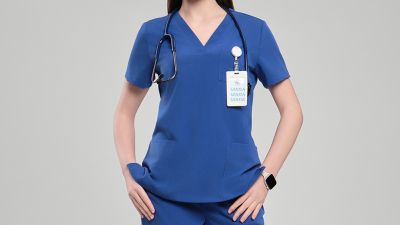
Royal blue women’s scrubs offer dental office teams a polished, coordinated look while supporting the practical demands of a busy workday. This two-piece uniform set includes a V-neck, short-sleeve top with a chest pocket and lower front pockets, paired with matching cargo pants. The women’s fit is designed for comfortable workwear, helping staff move through patient appointments and everyday clinic tasks with ease. Its bright, professional color gives the team a clean, confident appearance at the front desk, in treatment rooms, and throughout the office.
Suitable for dental practices, clinics, hospitals, nursing teams, wellness centers, and other healthcare settings, the set combines a consistent team look with useful everyday storage. Wholesale and bulk ordering options are available for practices and uniform distributors. OEM/ODM production, logo embroidery or printing, private labeling, and custom packaging can also be arranged to support team uniform programs and business-specific requirements.
Define fabric composition, garment weight, colors, stitching, pocket placement, and size grading. Clear details make quotes easier to compare.
Different sizes can fit or measure differently. Check seams, waistbands, and pocket placement before approving a larger order. Fit can surprise you.
Wash it repeatedly and check whether the color fades or measurements change. A polished sample may not match every production batch.
Request size charts, fabric details, inspection steps, and batch records. Keep sample approvals and material changes in writing.
Distributors may replenish stock faster. Manufacturers may offer more customization but require larger orders. Neither option is automatically better.
Confirm lead times, minimum order quantities, and delay updates. Fabric availability can shift schedules. Promises alone are not a plan.
Sizes may vary between batches, or defects may be difficult to resolve. Ask how problems are handled before ordering.
Review a small trial order and inspect the delivered garments. Share specific feedback. No checklist catches everything.
This guide explains how Nursing Scrubs suppliers serve global buyers, from product development and fabric selection to customization, packaging, and export coordination. It outlines how the 2026 supply market is organized and highlights the qualities that set strong suppliers apart, including dependable communication, consistent workmanship, flexible product ranges, and the ability to support different order sizes. Buyers can use practical criteria to compare garment styles, sizing, materials, construction, and quality-control processes before making a sourcing decision.
The guide also considers how to evaluate pricing alongside production capacity, lead times, delivery reliability, and order flexibility. It recommends checking relevant product documentation, workplace practices, and sustainability information as part of supplier assessment. By weighing these factors together and confirming expectations through clear specifications and sample reviews, global buyers can identify a suitable partner and build a more reliable long-term sourcing relationship.