inquiry now
Leave Your Message
0%

Picking the top Scrubs Uniforms manufacturers in China for global buyers isn’t just about comparing factory prices anymore. Hospitals, distributors, and private clinics all need garments that can really handle the daily grind—think repeated washes, long shifts, and lots of movement. So, this guide isn’t just about glancing at shiny catalogs; it dives into real-world sourcing experiences, production skills, fabric quality, and how reliable the manufacturers are at communicating. We look at details like cotton-polyester blends, stretch panels, colorfastness, seam strength, and consistent sizing—because honestly, tiny things matter. A pocket that tears open or a collar that loses its shape can seriously mess with a busy healthcare routine. Plus, having verified info—such as factory audits, sample reviews, test reports, and references—beats relying solely on polished images any day.

We also compare things like private-label options, minimum order quantities, how fast they can send samples, how they package everything, and their export experience. Trustworthy suppliers are upfront about fabric content and don’t hide production limitations before payment. They should also provide traceable inspection reports and do thorough pre-shipment checks. Of course, no manufacturer’s perfect—sometimes, a responsive sales team might overlook a measurement detail, or a low quote might hide issues like weaker elastic or dyeing problems that become costly to fix later. That’s why it’s all about finding the right balance between cost, quality, and long-term support.

The companies featured here are suggestions, not set-in-stone recommendations. Buyers should always double-check things like certifications, factory ownership, lead times, and specific destination needs—which is a step easy to forget but super important to avoid surprises down the line. All in all, this guide aims to help global buyers pick the right scrubs with clearer info, fewer assumptions, and a better fit for their operations.

China Top Scrubs Uniforms Manufacturers for Global Buyers

Understanding China’s Scrubs Uniforms Manufacturing Industry

China’s scrubs uniform industry combines textile mills, garment workshops, and export-oriented factories. Major production areas provide access to fabric, dyeing, cutting, sewing, and packaging. This structure can shorten product development time. It can also complicate supplier evaluation. A trading office may not own production equipment. Ask for factory details. Photos alone are insufficient.

Professional buyers usually begin with fabric performance, not appearance. Common requirements include breathability, colorfastness, stretch recovery, and washing resistance. Request fabric composition and test reports before approving samples. Check seam density, pocket reinforcement, zipper movement, and label accuracy. A practical sample should be washed several times. Small faults often appear later. That is where judgment matters.

Reliable manufacturers explain minimum order quantities, lead times, inspection stages, and corrective procedures clearly. Written specifications reduce disputes over shade, sizing, and packaging. Independent pre-shipment inspection adds useful evidence. Buyers should verify social responsibility and chemical compliance for each destination market. Certification claims require scope and validity checks. Attractive samples can hide inconsistent bulk production. This remains an uncomfortable lesson. Build approval around measurable details. Keep communication records. A dependable partnership grows through repeatable controls, not promises.

Key Product Types Offered by Chinese Scrubs Uniforms Manufacturers

China’s scrubs uniform manufacturers serve hospitals, clinics, laboratories, and distributors worldwide. Grand View Research estimates the global medical scrubs market reached approximately US$1.1 billion in 2023. It also projects near 6% annual growth through 2030. This demand supports flexible Chinese production.

Core products include V-neck tops, round-neck tops, straight-leg trousers, jogger trousers, and two-piece sets. Buyers can request stretch fabric, side vents, multiple pockets, and adjustable waistbands. Many factories also produce warm-up jackets, maternity scrubs, and pediatric sizes. Small details matter. A deep pocket can hold a phone, penlight, and folded gauze without pulling the fabric.

Logo Scrubs are another common private-label option. Manufacturers may add embroidery, heat-transfer marks, woven labels, or printed size information. Buyers should confirm thread color, placement, washing resistance, and minimum order quantities before production. A technical pack with measurements reduces costly revisions.

Fabric selection needs practical testing. The U.S. Centers for Disease Control and Prevention emphasizes proper garment handling and hygiene in healthcare environments, while textile testing standards commonly assess colorfastness, shrinkage, abrasion, and seam strength. Cotton-polyester blends offer easy care, while four-way stretch fabrics improve movement. Antimicrobial claims require evidence, not attractive wording. Some suppliers still describe fabric performance too broadly. I would request laboratory reports, sample washing records, and a pre-shipment inspection. Even a well-sewn sample can fail after repeated industrial laundering.

How to Evaluate Quality, Materials, and Production Standards

China Top Scrubs Uniforms Manufacturers for Global Buyers

How to Evaluate Quality, Materials, and Production Standards

When evaluating Nursing Scrubs suppliers in China, begin with fabric evidence, not product photos. Request fiber composition, fabric weight, shrinkage results, and colorfastness reports. A cotton-polyester blend often balances comfort, durability, and easier care. However, a heavier fabric is not automatically better. It may feel warm during long clinical shifts.

Inspect a sample after repeated washing. Check whether the neckline twists, pockets sag, or seams open near the side vents. Look closely. Measure the garment before and after washing, then compare the results with the supplier’s written specifications. In my experience, small measurement changes can affect movement and professional appearance. Some buyers overlook thread tension, even though loose stitching becomes visible after regular use.

Production standards require more than a clean sample room. Ask for inspection procedures covering fabric arrival, cutting accuracy, sewing, pressing, packing, and final sampling. Reliable manufacturers should provide batch records and explain how defects are isolated. Confirm whether testing uses an independent laboratory when required. Review workplace and chemical compliance documents relevant to your market. Documentation can be incomplete. That deserves a direct question, not an assumption of quality. A trial order can reveal packing errors, inconsistent sizing, and communication gaps before larger production begins.

Leading Manufacturing Regions and Supplier Capabilities in China

China’s scrubs manufacturing network is concentrated in several practical regions. Guangdong offers flexible Fashion Scrubs production, quick sampling, and strong export experience. Jiangsu is known for organized garment facilities and stable fabric sourcing. Zhejiang supports efficient cutting, sewing, printing, and mid-volume orders. Shandong also provides competitive capacity for larger uniform programs.

Supplier capabilities vary more than regional labels suggest. Experienced factories can develop women’s, men’s, and unisex medical uniforms with stretch fabric, side vents, reinforced seams, and multiple pockets. Some maintain in-house pattern rooms, while others outsource embroidery or fabric finishing. This difference affects lead times and quality control. Buyers should request production samples, fabric test reports, measurement charts, and documented inspection procedures.

A reliable evaluation includes factory videos, audit records, and clear communication about minimum order quantities. Check colorfastness after repeated washing, especially for dark navy and bright colors. Small details matter. Pocket depth matters. Stitch tension matters. A clean sample does not always represent bulk production. That is a weakness worth admitting. Independent inspections can reduce surprises before shipment. Buyers should also confirm worker safety practices, packaging standards, and export documentation. Price alone is a poor measure of manufacturing strength.

China Top Scrubs Uniforms Manufacturers for Global Buyers - Leading Manufacturing Regions and Supplier Capabilities in China

Manufacturing Region Representative Apparel Clusters Relevant Scrubs Manufacturing Strengths Common Fabric Options Customization Capabilities Quality and Compliance Support Export and Logistics Advantages
Jiangsu Nantong, Suzhou, Changzhou and nearby textile areas Strong woven-garment production, mature sewing capacity, private-label uniform programs and stable repeat-order manufacturing Polyester-cotton poplin, cotton-rich twill, stretch woven fabric, polyester-spandex blends and recycled polyester options Medical tops, jogger pants, straight-leg pants, lab coats, jackets, embroidery, heat-transfer decoration, custom labels and size grading Pre-production samples, measurement inspections, colorfastness testing and third-party inspection can be arranged according to buyer requirements Well-developed textile supply chain and access to major container ports in the Yangtze River Delta, including Shanghai and nearby regional ports
Zhejiang Shaoxing, Hangzhou, Ningbo and Yiwu-linked supply networks Broad fabric sourcing, flexible small-to-medium order production, fast sample development and extensive accessory availability Polyester-spandex stretch fabric, bamboo-blend fabrics, rayon blends, antimicrobial-finish fabrics when specified and easy-care woven materials Color matching, contrast panels, V-neck and crossover-neck designs, multiple pocket layouts, reflective details and packaging customization Fabric composition verification, dimensional stability checks, sewing quality inspection and documentation for buyer-specific restricted-substance requirements Dense fabric and garment ecosystem with convenient access to Ningbo-Zhoushan Port and other East China shipping services
Guangdong Guangzhou, Dongguan, Foshan, Zhongshan and Shenzhen-area manufacturing networks Fast-turn fashion-oriented production, sportswear-style scrubs, lightweight uniforms and strong decoration and packaging services Lightweight polyester blends, moisture-management knits, four-way stretch fabric, cotton-polyester jersey and performance fabrics Athletic-fit silhouettes, rib-knit panels, custom waistbands, digital printing, screen printing, embroidery and coordinated accessories In-line inspection, final random inspection, needle and sharp-object control procedures, and product testing through qualified external laboratories when required Strong international sourcing infrastructure and access to major South China gateways, including Shenzhen and Guangzhou-area ports
Shandong Qingdao, Jinan, Weifang and surrounding textile and garment areas Cost-effective cut-and-sew production, durable workwear construction and experience with institutional and industrial uniforms Cotton-polyester blends, durable twill, ripstop, poly-cotton poplin and heavier fabrics for outer layers Reinforced seams, utility pockets, snap or zip closures, unisex sizing, workwear-style jackets and custom measurement charts Seam-strength checks, fabric weight verification, colorfastness testing and factory quality-control procedures based on purchase specifications Qingdao provides an established export gateway for Northern China and supports container, air-freight and multimodal logistics
Fujian Quanzhou, Shishi, Xiamen and nearby sportswear and garment clusters Performance apparel expertise, comfortable stretch garments, quick-dry designs and sportswear-inspired medical uniforms Polyester-spandex, nylon-spandex, moisture-wicking knits, interlock and lightweight recycled synthetic fabrics Jogger-style bottoms, athletic tops, elasticated waistbands, stretch cuffs, sublimation graphics and coordinated clinic apparel Fabric performance testing, wash testing, print durability checks and buyer-approved pre-shipment inspection processes Strong regional sportswear supply chain and access to Xiamen and other Southeast China export routes
Hubei and Central China Wuhan and other inland garment-production areas Competitive labor and operating costs, scalable basic uniform production and suitability for standardized repeat programs Polyester-cotton, cotton-rich, basic stretch woven fabrics and commonly available uniform textiles Core scrub sets, standard color ranges, logo application, custom hangtags, carton marking and size-set development Standard inspection plans, sample approval, measurement control and testing arranged to meet the destination market and buyer specification Inland location can reduce factory overhead; rail, road and river connections link production with coastal export ports

Note: Capabilities, certifications, minimum order quantities, lead times and testing results vary by factory and must be confirmed during supplier qualification and sample approval.

Custom Design, Branding, and Private Label Services

Global buyers increasingly seek more than standard scrubs. They need recognizable, practical, and consistent apparel. China-based manufacturers now support custom design, branding, and private label production for hospitals, clinics, distributors, and care teams.

Grand View Research reports that the global medical clothing market was valued at approximately USD 42.8 billion in 2023. It also expects continued growth through 2030. This demand encourages manufacturers to offer detailed customization. Buyers can select fabric weight, stretch level, pocket layouts, collar shapes, and color systems. A practical design should survive repeated industrial washing. It should also remain comfortable during long shifts. Small details matter.

Branding requires control. Manufacturers can add woven labels, heat-transfer marks, embroidery, packaging, and size stickers. Private label services may include pattern development, sample approval, bulk production, inspection, and export documentation. According to a 2023 Deloitte healthcare supply chain report, visibility and supplier collaboration remain important for reducing operational risk. Clear specifications help. So does a written approval process.

The first sample is rarely perfect. That is normal. A sleeve may feel tight, or a logo may look too large after washing. Reliable suppliers should test these points before production. Buyers should request fabric reports, color references, measurement charts, and pre-shipment inspection records. The process takes patience, but rushed approval can create expensive mistakes.

Ordering, Compliance, Pricing, and Export Considerations for Global Buyers

Selecting China-based scrubs uniform manufacturers requires more than comparing catalog prices. Experienced buyers request fabric samples, size charts, stitching photos, and production records before placing large orders. Short Sleeve Scrubs should be checked for colorfastness, shrinkage, pocket strength, and comfort after repeated washing. A low quote can hide weak fabric or costly rework.

Ask for a written quotation with MOQ, sample fees, tooling charges, payment terms, and delivery time. Confirm whether pricing uses FOB, CIF, or another agreed trade term. Small orders may carry higher unit costs. That is normal. However, unclear charges deserve attention. I once underestimated packaging volume, which increased freight costs noticeably.

Compliance must be verified before production. Request fiber-content details, chemical safety declarations, labeling guidance, and test reports from qualified laboratories. Requirements differ by destination, so the importer should confirm local textile and medical-workwear rules. Export documents may include the commercial invoice, packing list, transport document, and certificate of origin. Check every name, quantity, and carton mark carefully. One wrong carton count can delay customs clearance. Factories should also explain their quality inspection process, including measurement tolerance and final random checks. Photos help, but they cannot replace independent inspection. Allow time for corrections; rushed shipments often create avoidable problems.

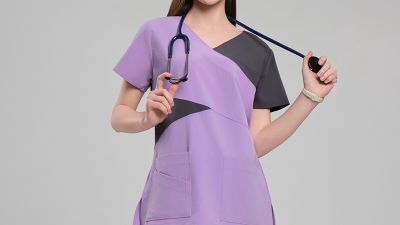
Purple Gray Sanxia Scrubs for Women in Dental Offices: Style, Comfort, and Professional Performance

Purple-gray women’s scrubs are becoming a practical choice for dental offices that want a consistent, polished team appearance without sacrificing daily comfort. The U.S. Bureau of Labor Statistics projects employment of dental assistants to grow 8% from 2023 to 2033, faster than the average for all occupations, increasing the need for functional, professional workwear. This women’s scrub set combines an asymmetric V-neck short-sleeve top with gray contrast panels, lower front patch pockets, a side-slit hem, and matching purple cargo pants. The color-block design creates a distinctive healthcare uniform suitable for dental clinics, hospitals, nursing teams, beauty clinics, wellness centers, and spa facilities.

Comfort and movement are especially important during long clinical shifts. The women’s fit and practical cargo-pocket layout support routine tasks, while the professional silhouette helps maintain a coordinated appearance for front-desk, chairside, and treatment-room staff. The U.S. Bureau of Labor Statistics also projects 6% growth in registered nursing employment from 2023 to 2033, reflecting continued demand for dependable medical apparel across healthcare settings. For distributors and organizational buyers, the set supports bulk and wholesale orders, team uniform programs, OEM/ODM production, logo embroidery, logo printing, private labeling, and custom packaging, allowing dental offices and healthcare teams to align uniforms with their operational and presentation needs.

FAQS

What makes China’s scrubs manufacturing industry efficient?

Textile mills, dyeing facilities, sewing workshops, and packaging suppliers often operate nearby. This can shorten sampling and development time. The structure is not always simple.

How can buyers verify whether a supplier owns a factory?

Ask for production equipment details, factory videos, and current workshop information. A trading office may not own machinery. Photos alone prove little.

Which fabric qualities matter most for scrubs?

Check breathability, stretch recovery, colorfastness, and resistance to repeated washing. Request fabric composition and test reports before approving samples. Appearance is not enough.

What should buyers inspect on a sample garment?

Examine seam density, pocket reinforcement, zipper movement, and label accuracy. Measure pocket depth with a ruler. Wash the sample several times. Small faults may appear later.

Which Chinese regions support scrubs production?

Guangdong often supports flexible production and quick sampling. Jiangsu offers organized garment facilities and stable fabric sourcing. Zhejiang handles cutting, sewing, printing, and medium-volume orders. Shandong can support larger uniform programs.

Do all regional suppliers offer the same capabilities?

No. Supplier abilities vary considerably within each region. Some factories develop women’s, men’s, and unisex uniforms. Others outsource embroidery or fabric finishing. Outsourcing may affect lead times and quality control.

What documents should buyers request before placing an order?

Request measurement charts, fabric reports, production samples, inspection procedures, and audit records. Written specifications should cover colors, sizes, packaging, and labeling. Keep communication records. They can prevent avoidable disputes.

How can buyers reduce bulk-production risks?

Use staged inspections, including independent pre-shipment inspection when practical. Check dark navy and bright colors after repeated washing. Confirm worker safety, chemical compliance, and export documentation. A clean sample can still hide inconsistent bulk production. That uncomfortable lesson deserves attention.

Conclusion

China’s Scrubs Uniforms manufacturing industry offers global buyers a broad range of medical apparel, including scrub tops, pants, jackets, dresses, caps, and coordinated accessories. Manufacturers commonly provide options in cotton blends, polyester, stretch fabrics, and performance materials designed for comfort, durability, easy care, and frequent washing. Buyers should assess fabric composition, stitching, colorfastness, size consistency, packaging, inspection procedures, and production certifications before placing an order. Major manufacturing regions differ in their strengths, from large-scale production and competitive pricing to specialized garment development and flexible small-batch capabilities.

Many Chinese suppliers support custom designs, embroidery, printing, size grading, color matching, private labeling, and customized packaging. Global buyers should clearly confirm technical specifications, minimum order quantities, sample approval procedures, lead times, payment terms, shipping arrangements, and documentation requirements. Careful supplier evaluation, quality control, and compliance checks can help reduce production risks while achieving reliable quality and cost efficiency. With clear communication and a well-defined purchasing plan, buyers can build stable supply relationships for healthcare uniforms in different markets.

Isabelle

Isabelle

Isabelle is a seasoned marketing professional with a wealth of expertise in the protective gear industry. Since joining Chengdu Sanxia Technology Co., Ltd. in 2013, she has dedicated herself to understanding the nuances of the company's core offerings, which include protective clothing, footwear,......
Previous 2026 Top Nurse Uniforms for Global Buyers